

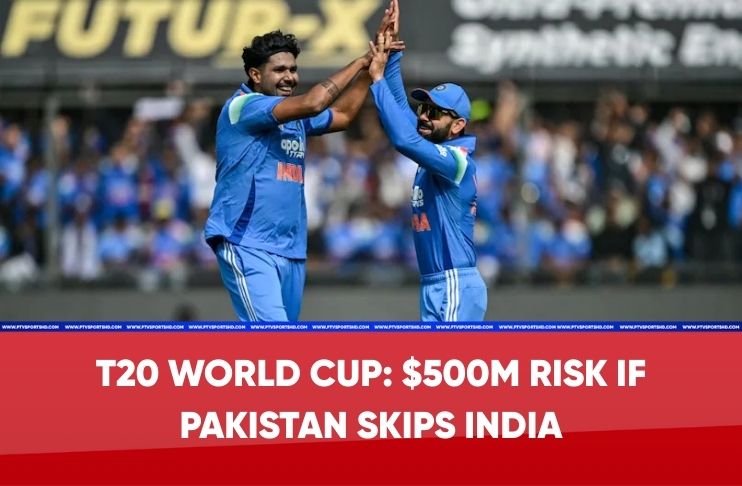
The ICC Men’s T20 World Cup 2026 could face one of its biggest commercial setbacks if Pakistan opts out of playing its scheduled high-profile match against India, a decision that may trigger financial losses estimated at nearly $500 million across the global cricket economy.
Earlier this week, the Pakistani government cleared the national men’s team to participate in the T20 World Cup after prolonged uncertainty. However, approval was granted with a significant condition: Pakistan will not take the field against India in their league-stage encounter scheduled for February 15. The move has sent shockwaves through the cricketing world, particularly among broadcasters, sponsors, and governing bodies.
According to a report by Indian media outlet NDTV, a single India-Pakistan T20 match carries immense commercial value. The combined worth—factoring in broadcast rights, premium advertising slots, sponsorship campaigns, ticket sales, and ancillary commercial activities—is estimated at around $500 million (Rs 450 billion).
Broadcasting companies are expected to take the immediate hit. Advertising rates during India-Pakistan fixtures are significantly higher than any other group-stage or knockout matches. A 10-second commercial slot during such a clash reportedly costs between Rs 2.5 million and Rs 4 million, far exceeding rates for other marquee encounters involving India.
The report further claims that advertising revenue generated solely from India and Pakistan markets could reach Rs 3 billion, revenue that would be wiped out if the match is forfeited. As the official rights holder, the broadcaster stands to lose the largest share, while ripple effects would be felt across multiple stakeholders.
The Board of Control for Cricket in India (BCCI) is also expected to suffer immediate financial damage. Estimates suggest losses of around Rs 2 billion, stemming from reduced sponsorship activation, viewership decline, and disrupted commercial agreements tied to the fixture.
Former Pakistan wicketkeeper-batter Rashid Latif weighed in on the situation, explaining both the significance and consequences of the decision. Speaking to the Times of India, Latif said that 60 to 70 percent of global World Cup viewership is driven primarily by India-Pakistan encounters.
“When a market of this magnitude is disturbed, the damage doesn’t stop with one broadcaster,” Latif explained. “India is affected, the BCCI is affected, and eventually the ICC also feels the impact.”
Latif further warned that the consequences would extend beyond South Asia. He noted that cricket boards in Australia and England, which benefit financially from global tournament revenues and shared ICC distributions, would also experience indirect losses if the marquee clash does not take place.
With the ICC Men’s T20 World Cup positioned as one of the most commercially lucrative events in world cricket, the uncertainty surrounding the India-Pakistan fixture has raised serious concerns about the tournament’s financial stability and global viewership appeal.
As discussions continue behind the scenes, the cricketing world watches closely, aware that the fate of a single match could reshape the financial landscape of the entire World Cup.
Read More: Pakistan Team departs for Sri Lanka for T20 World Cup 2026
