

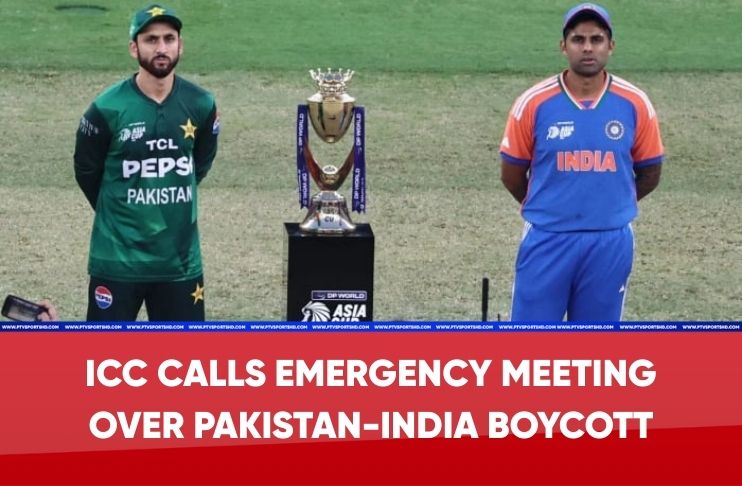
DUBAI: The International Cricket Council (ICC) has convened an urgent virtual Board meeting following Pakistan’s decision to boycott its highly anticipated group-stage clash against India in the ICC Men’s T20 World Cup 2026, escalating tensions within the global cricketing community.
The match between the two arch-rivals is scheduled for February 15, 2026, in Sri Lanka and is widely regarded as one of the most commercially valuable fixtures in international cricket. However, the Government of Pakistan announced on Sunday that its national team will not take the field against India, despite being permitted to participate in the rest of the tournament.
The decision was formally communicated through an official government social media account after a high-level meeting between Prime Minister Shehbaz Sharif and Pakistan Cricket Board (PCB) Chairman Mohsin Naqvi. The statement made it clear that while Pakistan will remain part of the T20 World Cup, it has been instructed to abstain from the match against India.
The move has triggered serious concern within the ICC, which confirmed that it is awaiting written clarification from the PCB. In an initial response, the global governing body expressed strong disappointment, stating that selective participation undermines the fundamental principles of a global sporting event and threatens the integrity of the competition.
According to ICC officials, tournament regulations require teams to honor all scheduled fixtures. Any failure to do so could constitute a breach of participation agreements signed by member boards. The emergency Board meeting is expected to examine the legal, financial, and sporting implications of Pakistan’s stance.
Sources familiar with the discussions suggest the ICC may consider disciplinary action if the boycott is formally confirmed. Potential consequences reportedly include substantial financial penalties for the PCB and, in extreme scenarios, restrictions on Pakistan’s participation in future ICC tournaments.
Other measures under consideration include limitations on Pakistan’s bilateral cricket engagements with leading nations and possible constraints affecting the Pakistan Super League, including foreign player participation. The PCB could also face compensation claims from broadcasters and commercial partners due to projected revenue losses from the cancelled high-profile fixture.
PCB Chairman Mohsin Naqvi has recently voiced frustration with the ICC, accusing the organization of inconsistent governance and favoritism. The current standoff comes amid lingering dissatisfaction over recent scheduling decisions, including the late replacement of Bangladesh with Scotland in the tournament lineup, which reportedly added to PCB grievances.
While acknowledging the authority of national governments, the ICC has urged the PCB to reassess its position in the broader interest of the sport. Officials emphasized that cricket’s global appeal depends on fair competition, unity, and adherence to agreed frameworks.
As the situation unfolds, the ICC Board’s decision could have long-lasting consequences not only for Pakistan cricket but also for the governance and commercial stability of future global tournaments.
Read More: T20 World Cup 2026: No Shift Planned Despite Nipah Fears
